Does a VPN Actually Unblock Netflix Libraries?
10 min read
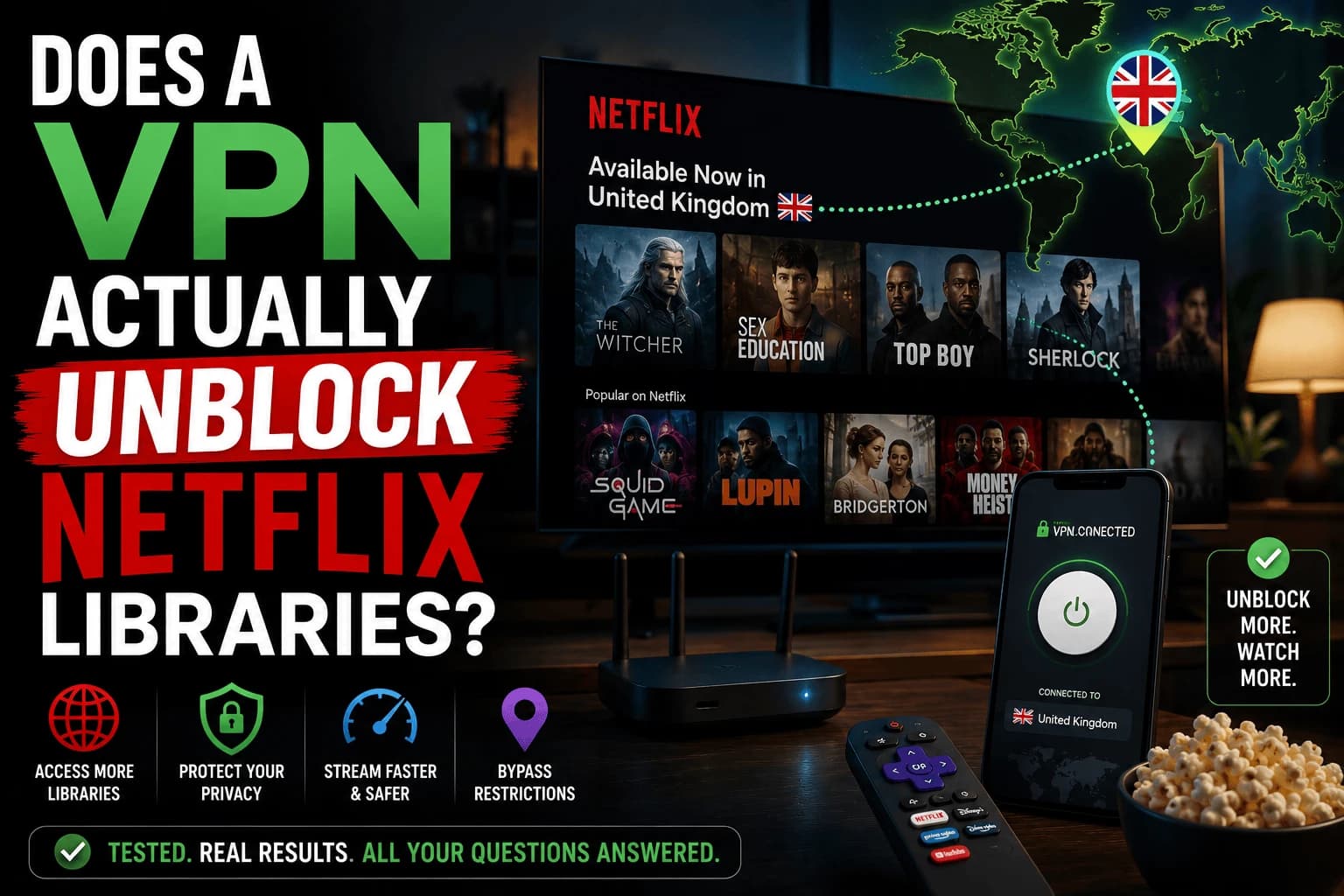
"Unblock Netflix libraries" is one of the most common claims in VPN marketing, and it's also one of the least reliable in practice. Here's what's actually happening technically, and why the claim doesn't hold up as consistently as ads suggest.
How Netflix decides which library you see
Netflix determines your regional library primarily based on your IP address's detected location. A VPN changes your visible IP address to one associated with a different country's server, which in theory makes Netflix think you're browsing from there instead.
Why it doesn't always work
Netflix actively maintains detection systems specifically to identify and block known VPN server IP addresses. This is a genuine ongoing arms race: a VPN provider spins up new servers, Netflix's systems eventually detect and blacklist them, the provider rotates to new IPs, and the cycle repeats. This means a server that successfully unblocks a specific library today has no guarantee of still working next week.
The licensing reason behind the blocking
This isn't Netflix being arbitrarily restrictive. It's contractual. Netflix licenses different content in different countries based on regional rights deals with studios and distributors. Allowing unrestricted access across regions would violate those agreements, which is why Netflix invests real resources in detecting and blocking VPN traffic specifically.
"Streaming-optimized servers" is marketing language for "we rotate IPs more often"
There's no secret streaming technology hiding inside a server labeled "optimized for streaming." What that label actually means, stripped of the marketing gloss, is that the provider is putting in more manual effort. Checking those specific IPs against Netflix's blocklist more frequently and swapping them out faster than their general-purpose servers. It's real work that improves your odds. It is not a technical breakthrough, and it's not a permanent fix.
The realistic expectation
A VPN may work to access a different Netflix library some of the time, particularly right after a provider rotates its server IPs. It is not a reliable, permanent solution, and providers that heavily advertise this feature are competing in a race they don't fully control, since Netflix's detection systems are the ones setting the terms.
Setting the right expectations
If unblocking regional libraries is your primary reason for buying a VPN, go in with realistic expectations: it's an inconsistent bonus, not a guaranteed feature. For streaming privacy, ISP throttling avoidance, and general security, a good VPN still earns its cost regardless of whether regional unblocking happens to work on any given day.
How the detection actually works
Netflix uses several signals together, which is why some workarounds fail even when your IP address looks correct.
IP reputation databases catalogue address ranges belonging to hosting providers and data centres. Residential connections come from ranges assigned to consumer ISPs; VPN servers almost always sit in data centres. That mismatch alone flags a connection regardless of which country the address claims.
DNS mismatches catch a different case. If your traffic exits in one country but your DNS lookups resolve somewhere else, the inconsistency is visible. This is why a VPN can appear connected while Netflix still shows your real library — the IP moved and the DNS didn't.
Account region matters too. Your billing country determines which library the app defaults to on some platforms, independent of your connection.
The proxy error, and what it actually means
The streaming error referencing a proxy or unblocker means Netflix has flagged your IP as belonging to a VPN. Note what it doesn't mean: your account isn't in trouble, and nothing is broken on your end.
Netflix's stated approach is to serve only content licensed globally in this situation rather than blocking access outright, which is why you can often still watch Netflix originals while everything else disappears. That behaviour is the giveaway that you're being detected rather than experiencing an outage.
The practical response is to try a different server in the same country. Providers run many, and they're rarely all flagged at once.
Why smart TVs and streaming sticks are harder
Even with a working VPN, TV platforms create problems that don't exist on a laptop.
Many smart TVs and streaming devices ignore custom DNS settings and use hardcoded DNS servers, which produces exactly the mismatch described above. Some apps also read location from the device's own region setting rather than the connection, so changing the VPN alone achieves nothing.
Router-level VPN configuration avoids some of this by moving the tunnel upstream of the device, though it doesn't solve hardcoded DNS. Our guide to router-level VPN covers that setup and its limits.
Is it against the terms of service?
Worth being straightforward here. Using a VPN to access a different regional library is generally against Netflix's terms of use, which specify you'll access content from the region you're in. In practice Netflix enforces this by restricting content rather than by penalising accounts. The documented behaviour is the proxy error, not suspension.
The licensing agreements behind this are real contractual obligations to studios rather than arbitrary policy, which is why the enforcement effort is sustained rather than occasional.
What a VPN reliably does for streaming
Setting library-switching aside, the dependable benefits:
- Prevents ISP throttling of video traffic: some ISPs slow streaming specifically, and a VPN hides which traffic is video
- Hides viewing activity from the network operator: relevant on shared, work or public connections
- Protects the connection on public Wi-Fi, covered in our guide to public Wi-Fi safety
These work consistently, unlike regional unblocking. If you're choosing a provider primarily on unblocking claims, you're optimising for the least reliable thing a VPN does.
Related reading
- What actually matters in a streaming VPN
- Free vs paid: free tiers are almost never detected as residential
- VPN split tunneling explained: routing only the streaming app through the tunnel
Frequently Asked Questions
Is it legal to use a VPN to access a different Netflix library?
Using a VPN itself is legal in most countries. However, accessing content licensed for a different region violates Netflix's terms of service, which is a contract issue rather than a criminal one — consequences are typically limited to a blocked stream, not legal action.
Why does Netflix block VPN traffic?
Netflix is contractually required by content licensors to restrict shows and movies to the regions where the license was purchased. Allowing unrestricted VPN access would violate those licensing agreements.
Which VPNs are best at unblocking Netflix?
This changes constantly as Netflix updates its detection and VPN providers adjust their infrastructure in response. Providers that maintain dedicated "streaming-optimized" servers generally have better and more consistent success than general-purpose servers.
Does a VPN reduce Netflix streaming quality?
When it works, quality is usually unaffected on a fast connection. The bigger issue is reliability — a server that unblocks a library today may get detected and blocked within days or weeks.
What does the Netflix proxy error actually mean?
It means Netflix has flagged your IP address as belonging to a VPN. Your account is not in trouble and nothing is broken — Netflix responds by serving only content licensed globally, which is why Netflix originals often still play while everything else disappears. Trying a different server in the same country usually resolves it.
Why does my VPN connect but Netflix still shows my real library?
Usually a DNS mismatch: your traffic exits in one country while your DNS lookups still resolve somewhere else, and the inconsistency is visible to Netflix. On smart TVs this is common because many devices ignore custom DNS settings and use hardcoded servers regardless of the VPN.
Why is it harder to use a VPN with Netflix on a smart TV?
Two reasons. Many smart TVs and streaming sticks ignore custom DNS settings, producing a mismatch that flags the connection. Some apps also read your location from the device's own region setting rather than the network connection, so changing the VPN alone achieves nothing.
Can Netflix ban my account for using a VPN?
It is against the terms of use, but Netflix enforces this by restricting content rather than penalising accounts — the documented behaviour is the proxy error, not suspension. The restrictions exist because of real licensing obligations to studios rather than arbitrary policy.