Free VPN vs Paid VPN for Streaming: What You Actually Lose
10 min read
"Free" sounds appealing until you consider that running VPN server infrastructure costs real money, and free providers have to recoup that cost somehow. Here's where that cost actually shows up.
Data caps make streaming impractical
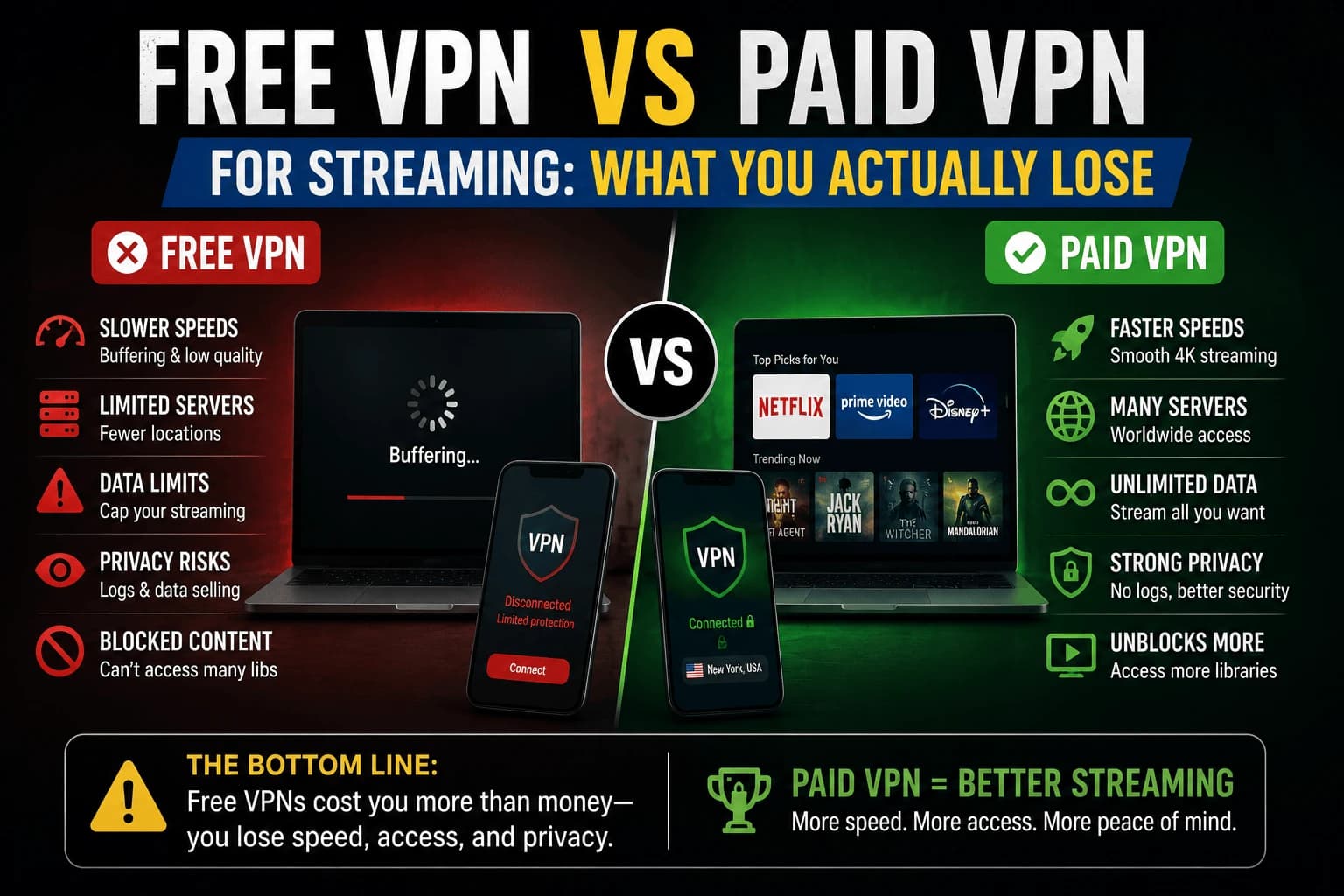
Most free VPN tiers impose a monthly data limit, figures vary by provider, but a handful of gigabytes per month is typical. A single hour of 4K video streaming can use several gigabytes on its own, meaning a free VPN's entire monthly allowance can be gone in an evening of normal viewing. This alone rules out free VPNs for regular streaming use, regardless of any other differences.
The slowdown is often the point, not a side effect
Plenty of free tiers throttle your connection speed on purpose: a built-in nudge toward the paid upgrade, stacked on top of the ordinary performance cost any VPN adds. Put that intentional throttling next to a data cap that runs out mid-binge, and the free-tier streaming experience frequently ends up worse than just not running a VPN at all.
A handful of countries to choose from, when you need dozens
Paid plans typically hand you servers scattered across dozens of countries. Free tiers hand you one or two, take it or leave it. That's not a minor inconvenience. It means you can't pick a nearby, uncongested server even if one exists, because the free tier never gave you the option in the first place.
The privacy question that matters most
This is the part that gets less attention than data caps. Running servers costs money, and if a provider isn't charging you directly, it needs another revenue source, commonly advertising, or in some documented cases, selling anonymized or aggregated user data to third parties. This doesn't apply to every free VPN, but it's a real enough pattern that it's worth actually reading a provider's privacy policy rather than assuming "free" means "no cost to you" in every sense.
When a free VPN is a reasonable choice
If you want to test whether you actually like using a VPN before committing to a paid subscription, a free tier from an otherwise reputable, established paid provider (rather than an obscure free-only app) is a reasonable way to get a feel for the experience — just go in expecting the data and speed limitations, not a full replacement for a paid plan.
What this means for regular use
For actual regular streaming use, the data caps and speed limits on free VPNs make them impractical regardless of any other consideration. A budget paid VPN, even at the lowest tier most reputable providers offer, delivers a fundamentally more usable experience for roughly what most people already spend on a single streaming subscription.
The features free tiers leave out
Beyond caps and speed, several things are routinely absent, and they're the ones that matter when something goes wrong:
- Kill switch. Frequently missing or non-functional on free tiers, meaning a dropped tunnel silently exposes your traffic. Our guide to how kill switches work covers why that gap matters.
- Split tunneling. Almost always paid-only, so it's all-or-nothing routing.
- Router support. Free tiers rarely permit router-level configuration, which rules out covering a smart TV or streaming stick that can't run VPN software itself.
- Simultaneous connections. Usually one device, so protecting a phone and a TV at once isn't possible.
- Modern protocols. Newer, faster protocols are often reserved for paying users, compounding the deliberate throttling.
The business model question
Server capacity, bandwidth and staff cost money. If you're not paying, that revenue comes from somewhere, and the common models are worth knowing:
Freemium: the free tier is a limited sample funding conversions to paid. This is the honest version, and it's why free tiers from established paid providers are the safer choice.
Advertising: the app shows ads, which usually means tracking to target them. A privacy tool that tracks you is working against its own purpose.
Data monetisation: the most concerning, and documented in specific cases: browsing data collected and sold onward. A VPN sits between you and everything you do online, which makes it an unusually valuable vantage point for anyone inclined to abuse it.
The useful question isn't whether a free VPN exists, but which of these is funding it. If the answer isn't obvious from the provider's own materials, that's informative in itself.
Reading a privacy policy quickly
You don't need to read the whole thing. Four things to look for:
- What's logged. "No logs" is marketing; the policy should specify whether connection timestamps, bandwidth and source IP are retained.
- Jurisdiction. Where the company is registered determines which authorities can compel disclosure.
- Third-party sharing. Look specifically for "affiliates", "partners" and "aggregated data" — the phrasing that covers onward sharing.
- Independent audits. Whether anyone external has verified the no-logs claim, and when.
A provider unwilling to state these plainly has told you what you needed to know.
When free genuinely makes sense
Not never — just narrower than the marketing implies:
- Trialling before subscribing, using a free tier from an established paid provider
- Occasional light use where a monthly cap is irrelevant
- A single low-stakes task rather than continuous protection
What free tiers don't suit is regular streaming. The data maths makes that clear before any other consideration.
Related reading
- What matters in a streaming VPN
- Kill switches: commonly missing on free tiers
- unblocking regional libraries: free tier IPs are detected almost immediately
Frequently Asked Questions
Are free VPNs actually free, or do they make money another way?
Most free VPNs monetize through advertising, selling anonymized usage data, or upselling to a paid tier. Running server infrastructure has real costs, so a completely free service with no clear revenue model is worth researching carefully before trusting it with your traffic.
Do free VPNs have data caps for streaming?
Most do — the exact allowance varies by provider, but a handful of gigabytes per month is typical, which is nowhere near enough for regular video streaming. A single hour of 4K content can use several gigabytes on its own.
Is it true that free VPNs sell your browsing data?
Some do, and it has been documented in a handful of well-known cases. This isn't universal to every free VPN, but it's a real enough pattern that reading a provider's actual privacy policy matters more with free services than paid ones.
Can I use a free VPN just to test if I like using a VPN at all?
Yes, that's a reasonable use case — a reputable provider's free tier (rather than an unknown free-only app) can give a fair sense of the experience before committing to a paid plan.
Do free VPNs have a kill switch?
Frequently not, or one that does not function reliably. It is one of the most common omissions, which matters because without it a dropped tunnel silently exposes your traffic with no indication anything changed. Split tunneling and router support are usually paid-only too.
How do I check whether a VPN provider is trustworthy?
Read four things in the privacy policy: exactly what is logged (not just a "no logs" claim), the jurisdiction the company is registered in, whether third-party or affiliate sharing is mentioned, and whether an independent audit has verified the logging claim. A provider unwilling to state these plainly has answered the question.
Why can free VPNs not be used on a smart TV or streaming stick?
Most free tiers do not allow router-level configuration, and many TV platforms cannot run VPN apps directly. Since router setup is the usual way to cover those devices, a free tier effectively cannot protect them. Free tiers also typically allow only one simultaneous connection.
Is a free VPN enough for occasional use?
For light, occasional use where a monthly data cap is irrelevant, a free tier from an established paid provider is reasonable. What it does not suit is regular streaming — a single hour of 4K can consume several gigabytes, so a typical monthly allowance disappears in one evening.